
How to Tell the Quality of Clothing Material and Why It Affects the Price
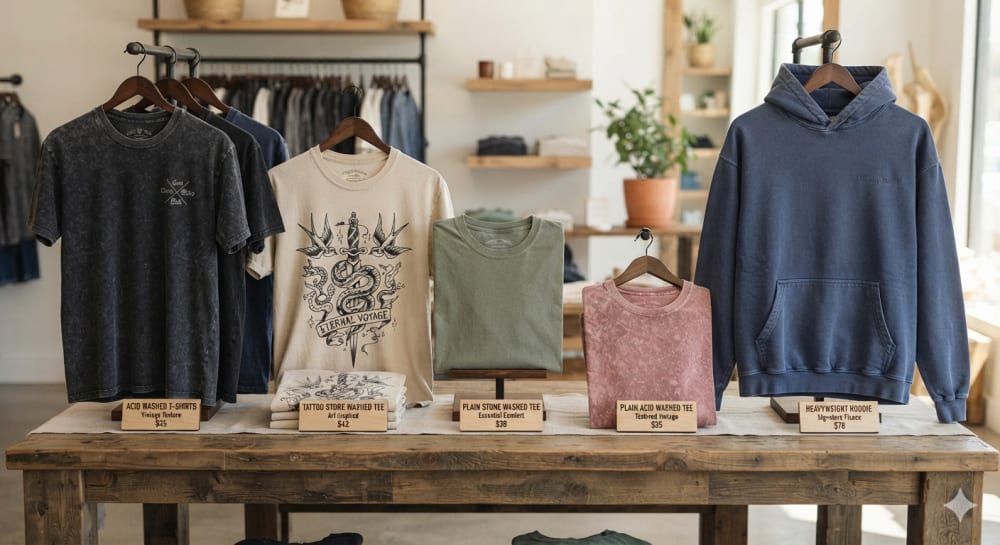
Two T-shirts can look identical on a hanger and cost wildly different amounts. One keeps its shape and colour for years; the other thins out, pills and twists after five washes. The difference is almost never the print or the label — it's the material and how it's made. This guide shows you how to judge clothing quality with your own eyes and hands, and explains why the better piece legitimately costs more.
1. Start with the fibre — it matters most
Before thread counts and finishes, ask one question: what is this actually made of? Fibre type is the foundation of quality, influencing softness, breathability, warmth, durability and wrinkle resistance more than any other single factor.
Natural fibres (cotton, linen, wool, silk) are generally more breathable, more comfortable and longer-lasting. Synthetics (polyester, nylon, acrylic, viscose) are cheaper and wrinkle-resistant, but are typically less breathable and less durable — which is exactly why budget and fast-fashion labels lean on them so heavily (Fashion Times).
Within cotton, two details separate premium from ordinary:
- Staple (fibre) length. Longer fibres bond into stronger, smoother, fuzz-free yarn. Long-staple cottons like Pima, Supima and Egyptian are prized for exactly this reason (The Apparel Factory).
- Combed vs carded. All cotton is carded (cleaned and aligned). Premium cotton is then combed — a fine-toothed machine removes the short fibres and neps that cause pilling, leaving smoother, stronger yarn. Combing produces noticeably better tensile strength and pilling resistance, but it discards roughly 15–20% of the fibre as waste, which is a real reason combed-cotton garments cost more (Fabriclore).
| Carded cotton | Combed cotton | |
|---|---|---|
| Process | Cleaned & aligned only | Carded + short fibres combed out |
| Feel | Coarser, slightly fuzzy | Smoother, softer |
| Pilling | More prone | Resists pilling |
| Cost | Lower | Higher (waste + extra step) |
2. Six quick tests you can do in the shop
You don't need a lab. These hands-on checks tell you most of what you need to know:
- The hand (feel) test. Quality cloth feels substantial and smooth, not thin, papery or plasticky. Scrunch it in your fist — good fabric springs back; cheap fabric stays creased.
- The weight test. Hold it up. Heavier, denser cloth (within reason) usually means more material and better durability — more on GSM below.
- The opacity / light test. Hold the fabric up to light. Very thin, see-through cloth (unless it's meant to be sheer) signals a loose, low-quality weave (Recovering Shopaholic).
- The stretch-and-recover test. Gently stretch and release. It should return to shape, not stay baggy.
- The rub test. Rub the surface briskly with your fingers. If little balls (pills) form quickly, the yarn contains short fibres — a quality red flag.
- The burn test (at home, with care). A tiny snipped thread tells you a lot: natural fibres burn steadily, smell like burning paper (cotton/linen) or hair (wool/silk), and leave a soft ash you can crush. Synthetics shrink away from the flame, melt into a hard plastic bead and smell chemical (EYSAN Fabrics). Do this safely over a sink with a single thread — and note it only works on 100% fibres; blends are unreliable (Threads Magazine burn chart).
3. Read the numbers: GSM and thread count
GSM (grams per square metre) measures fabric weight — literally how much one square metre weighs. Higher GSM = heavier, denser cloth. For T-shirts, the practical bands are (Printful, Stanley/Stella):
| Weight class | GSM | Feel & best use |
|---|---|---|
| Lightweight | 100–150 | Thin, breezy, summer/activewear |
| Midweight | 150–180 | The everyday all-rounder |
| Heavyweight | 180–240+ | Thick, structured, premium/durable |
(To convert GSM to oz/yd², divide by 33.9 — e.g. 180 GSM ≈ 5.3 oz.)
Thread count is the number of threads per square inch (warp + weft) — most relevant for woven items like shirts and bedding. Here's the catch most shoppers miss: a higher thread count is not automatically better. Manufacturers often count each ply of a twisted yarn separately, so a "600 thread count" sheet can really be the density of a 300 — inflated marketing (SELVANE). A tightly woven 300TC in long-staple cotton beats a loosely woven 600TC in short-staple cotton every time (Bed Bath & Beyond). And linen naturally has a low thread count because flax fibres are thick — so for linen, judge by GSM, not thread count (Foxtrot Home).
Rule of thumb: Fibre quality first, weave density second, the printed number last.
4. Construction: great cloth, badly sewn, is still cheap
Even excellent fabric fails if the garment is poorly made. Check the seams and stitching:
- Stitch density (SPI). More, tighter, even stitches per inch = stronger seams. Gaps and big holes mean low SPI (Styled by Science).
- Consistency. Stitch length should be even along the whole seam; wandering, uneven stitching is a workmanship red flag.
- The seam light test. Hold a seam to the light — a well-made seam lets almost no light through.
- Pattern matching. On stripes/checks, do the lines line up across seams and pockets? Mismatched patterns are a fast tell of a rushed, cheap make (Recovering Shopaholic).
- Finishing. Loose threads, raw edges, crooked hems and flimsy buttons all signal corners cut.
5. How quality drives the price
Better clothes cost more for concrete, defensible reasons — materials and labour are the two biggest costs in making any garment (Well Made Apparel vs Fast Fashion):
- Better fibre costs more — long-staple and combed cotton involve premium raw material and extra processing (and that 15–20% combing waste).
- Denser weaves use more yarn — higher GSM and tighter construction literally mean more material per garment.
- Real construction costs labour — reinforced stitching, proper linings and finishing take time and skill that a rock-bottom-price tee skips (Fashion Times).
- Ethics and durability — fast fashion's low prices are propped up by cheap synthetics and low-cost labour, with heavy environmental and social costs (Britannica: Fast fashion; Bick et al., peer-reviewed, Environmental Health).
The smartest way to compare price is cost-per-wear, not the sticker. A ₦4,000 shirt that survives 10 wears costs ₦400 a wear; a ₦12,000 shirt worn 100 times costs ₦120 a wear — and looks better the whole time. Durable, well-made clothing usually wins on true value.
6. Your 60-second quality checklist
- Check the fibre-content label (favour natural / long-staple / combed cotton)
- Feel the weight and scrunch-test for recovery
- Hold it to the light — not see-through
- Rub for pilling
- Inspect seams: tight, even, light-blocking, patterns matched
- Compare on cost-per-wear, not just the price
Buying in bulk? Quality protects your margin
If you're a reseller or boutique buying wholesale, fabric quality isn't just about feel — it's about returns, reviews and repeat customers. A heavier-GSM, combed-cotton tee that survives washing builds your reputation; a thin, pilling one quietly kills it. That's why it pays to source from a supplier who's transparent about fibre, GSM and construction. At Nasuru Clothings, we focus on quality cotton garments at honest wholesale prices — browse the collection or see today's deals.
Sources
- The Apparel Factory — Combed vs. Carded Cotton: https://theapparelfactory.com/blog/combed-cotton-vs-carded-cotton/
- Fabriclore — Combed and Carded Cotton differences: https://fabriclore.com/blogs/fashion-business-lifestyle-trends/differences-between-combed-and-carded-cotton
- Bed Bath & Beyond — Thread Count & GSM: https://www.bedbathandbeyond.com/guides/bedroom/everything-you-need-to-know-about-thread-count-gsm
- SELVANE — Thread count & fabric density explained: https://www.selvane.co/blogs/knowledge/understanding-thread-count-and-fabric-density-what-the-numbers-actually-mean
- Foxtrot Home — Guide to GSM & thread count: https://foxtrothome.co.nz/blogs/linen/a-guide-to-gsm-thread-count-in-fabric-and-identifying-quality-linen
- Printful — T-shirt weight guide: https://www.printful.com/blog/t-shirt-weight-guide
- Stanley/Stella — Why t-shirt weight matters: https://stanleystella.com/en-us/blog/post/t-shirts-why-weight-matters
- EYSAN Fabrics — Fabric fibre content burn test: https://www.eysan.com.tw/fabric-fiber-content-burn-test/
- Threads Magazine — Burn test chart (PDF): https://www.threadsmagazine.com/app/uploads/2013/06/T168_Burn_Test_Chart.pdf
- Styled by Science — How to check for well-made seams: https://styledbyscience.com/how-to-check-for-well-made-seams/
- Recovering Shopaholic — How to tell if a garment is well-made: https://recoveringshopaholic.com/2014/01/14/how-to-tell-if-a-garment-is-well-made/
- Fashion Times — Luxury vs Fast Fashion: https://www.fashiontimes.com/luxury-vs-fast-fashion-which-wins-clothing-quality-comparison-value-14025
- Britannica — Fast fashion: https://www.britannica.com/art/fast-fashion
- Bick, Halsey & Ekenga — The global environmental injustice of fast fashion (peer-reviewed): https://www.ncbi.nlm.nih.gov/pmc/articles/PMC6307129/